Showing posts with label Navratri special. Show all posts

Thursday, April 14, 2016

Ashtami prashad - Kaale Chhole, Poori & Atte Ka Halwa


Happy Durga Ashtami everyone! I am bringing to you the typical halwa, poori-chhole that is cooked early morning for the Ashtami pooja at my home and most other North Indian households. After nine days of Navratri and following a strict no non-vegetarian, no onion-garlic diet we conclude it on the eighth day called Ashtami by offering this prasad to Maa Durga the Goddess first and later feasting on this yummy authentic North Indian food for the rest of the day.

We try out the poori or fluffy deep-fried bread in so many ways in the same day. First we eat the hot, bubbling and fluffy poori straight out of the wok with spicy dry kaale chhole or black-brown chickpeas. Then hot and velvety atte ka halwa or wholewheat sweet pudding is slathered on top of the soft poori and devoured slowly taking in the taste of halwa and poori in every bite.


We eat such a packed breakfast of poori, chhole and halwa that lunch is skipped and then by 4 pm when the hunger again strikes, we go looking for some leftover pooris from the morning in the roti ka dabba or hot case and then eat them with aam ka achaar or raw mango pickle, washing it down with a cup of kadak chai.

So now you know what is on the menu in every North Indian house when it is Ashtami or Navmi! Nothing else is cooked afterwards as this dish is repeated in several combinations throughout the day. Dinner is mostly the leftover chhole with steamed rice or fresh phulkas or chapatti.


Kaale Chhole


The Kaale Chhole or  Sookhe Kaale Chane or Black Chickpeas (Dry) is a recipe from Punjab. These are super easy and since it is onion-garlic free it requires less chopping of veggies and if the chhole is pressure cooked in advance the tadka or tempering for this recipe can be prepared in under 30 minSince this is prasad for Ashtami pooja so no onion, no garlic is added. But still its yummy. :-) See the step-by-step recipe for Kaale Chhole here. 


Poori

Learn how to make fluffy poori from the step-by-step recipe provided here. For poori, I always prepare the dough well in advance. If I have to make it early in the morning I prepare the dough in the night and store it in fridge. I find it easier to handle the dough which has take its time to rest.


Halwa

Being a sweet dish, halwa is made on special occasions or festivals in most Indian households using different kinds of flour like suji (semolina) or atta (wholewheat flour) or mixing the two. When the bride comes to her new home after marriage, she is expected to make a signature halwa dish and that is the way she makes it into the hearts of her in-laws. :-)

It is fairly easy but still you need to be careful and keep stirring while roasting the flour in the ghee so that no lumps are formed. For the Atte Ka Halwa recipe click here!


Hope you all had a divine Ashtami. Happy Ashtami/Kanjak/Vishu to all those celebrating! :-)

Kaale Chhole (dry)

Kaale Chhole or Sookhe Kaale Chane or Black Chickpeas (Dry) is a recipe from Punjab. These are super easy and since it is onion-garlic free it requires less chopping of veggies and if the chhole is pressure cooked in advance the tadka or tempering for this recipe can be prepared in under 30 min.
During my school days, I remember trotting down to the gurudwara near my home every Saturday just to experience a melt in the mouth spicy tangy taste of kaale chhole. Kaale chhole ka prasad was distributed and I hope still is, in most gurudwaras on a Saturday. It is an out of the world experience to be the lucky one to get your hands on this yummy prasad.

Here is a recipe just how my mom makes it on early mornings each Ashtami or the eighth day of Navratri, the north Indian festival of fasting for nine days to cleanse and purify the soul and pray to the Goddess Durga. It is mostly eaten with hot and fluffy poori (deep-fried bread) or scooped with soft and fresh phulkas or chapatti.

Kaale Chhole

Difficulty Level: Easy
Prepping Time: 20 min
Cooking Time: 1 hour

Ingredients:


1.5 cup black chana or chickpea (soaked overnight in water)
3 large tomatoes, finely chopped
4-5 green chilies, finely chopped
1 tsp jeera/cumin seeds
4 tbsp cooking oil
1 tsp red chili powder
1 tsp chana masala
1 tsp coriander powder

Method:


1) Pressure cook chana for 30 min in 4-5 cups water.
2) Till the time the chana is done, in a wok heat cooking oil. Add jeera and let it crackle. Now put in chopped tomatoes and green chili and let it soften and form into a paste-like consistency. Stir in between.
3) When the oil has separated from the tomatoes, add in the red chili powder, chana masala, coriander powder and salt to taste. Stir.
4) Once the steam has evaporated from the pressure cooker. Open and check if the chana is soft and cooked.
5) Now add the chana to the tomato tadka prepared and let it simmer on low heat for 15 min. Serve hot with poori or chapatti.


Note:  At step 4, if the chana is still not cooked close the lid and let it whistle away for 15 min after adding the tadka to it.

How do you make your chana?

Do share with me your secret recipe!

Thanks for reading! :-)

Monday, April 11, 2016

Veg Pulao (No Onion-Garlic)


Navratri or the nine nights festivity comes twice a year, once before the onset of summers and then again just before winters. During the nine nights of navratri, the nine forms of mother goddess Durga are worshiped.

Many people in North and west India fast during the nine days of navratri. It is considered to be an auspicious time to start new ventures, plans and it is a time to get spiritual and worship and pray to Goddess Durga and purify the mind, body and soul of all the impurities and negativity.

Nine days of fasting include avoiding non-vegetarian and onion, garlic among a whole list of foods. For people who are fasting, the food is consumed only once or twice a day. Mostly fruits, milk or other dairy products, potatoes and selected veggies, and some forms of flour like kuttu ka atta (buckwheat flour), singhare ka atta (water chestnut flour), swaang ka atta (barnyard millet flour), swaang ke chawal (barnyard millet rice), sabudana (tapioca pearls), among others are consumed.

We oblige happily as this fasting time is more of a feast as a variety of dishes such as puri, pakoras, halwa, aloo tikki and stuffed flat bread are prepared at home using the flour specified above. Swaang ke chawal are used to make pulao (rice stirfry), dalia (porridge) and kheer (rice pudding). The vrat food or the food consumed when fasting is a whole different form of cuisine altogether.

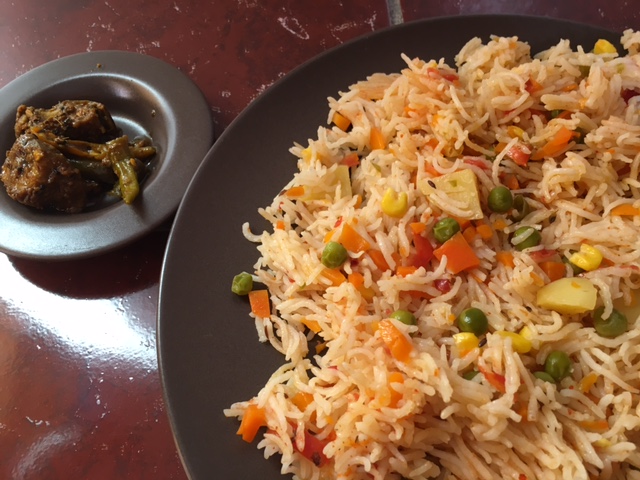
Even for people who are not fasting, it is required to go vegetarian and onion-garlic free for the entire navratri period. We abstain from the same and here I am sharing Vegetable Pulao, stir fry rice made with freshly chopped veggies that contain no onion and no garlic at all.

Pulao is one-pot Indian dish, which can be made quickly and consists of rice and veggies. Pulao is either served as a side dish with a curry or eaten as it is with yoghurt when you have no time to cook anything else. :-)


This Veg Pulao is simple and quick and is full of goodness of veggies. Since it doesn't have any garlic or spices, the original taste of vegetables is retained in the dish. One can very well taste the natural sweet taste of the corn, peas and carrot.

I do not have pictures to complement the procedure as I made these rice in the morning in a hurry. But I will try and explain the process step by step and it is very simple and easy to follow.

Difficulty Level: Easy
Prepping time: 10 min
Cooking time: 15-20 min

Ingredients:


1 cup Basmati rice (washed and soaked in water for at least 15 min)
1 small potato, cubed
2 carrots, finely chopped
1/2 cup peas
1/4 cup sweet corn
1 tsp jeera or cumin seeds
2 green chilies, finely chopped
1 tomato, finely chopped
2 tbsp ghee
1 tsp red chili powder
salt, to taste

Method:


1) In a wok, heat ghee and add cumin seeds. Let them flutter and golden and then add finely chopped green chili and tomato.
2) When tomatoes have a paste-like consistency and once the ghee has separated, add chopped carrots, potatoes, peas and sweet corn. Stir. Add a pinch of salt.
3) Add 1/4 cup water and close the lid and on low flame let the veggies soften in steam.
4) Open the lid and check if carrots, potatoes and peas are soft but not mushy. If the veggies are stiff, cover and cook for 2-4 min more.
5) When the veggies seem soft, add red chili powder, salt to taste and 2 cups water. Bring to boil and add rice. Bring it to boil again and cover and let the rice cook on low flame for 10 min.
6) Turn off the flame. Leave the wok covered for 5-10 min and then serve hot with pickle or yoghurt.


It is a surely a delicious lunch recipe and can be eaten with aam aur hari mirch ka achaar (raw mango and green chili pickle) or can be even had with any raita (yoghurt-based side dish generally made with boondi or chopped veggies like cucumber, onion etc) of your choice.


This colourful Veg Pulao made it into the lunch boxes for the husband and Little M. I would recommend everyone to try this pulao.

Wishing a happy Navratri to all the celebrating fellow Indians!

Please note that this recipe is apt for people who are not observing the fast but this is not a vrat food and cannot be eaten by those fasting.

Thanks for reading! :-)